My research is in part focused on astrophysical understanding of black holes and neutron stars and in part interdisciplinary, focusing on the overlap between statistics, data science and astronomy. A large part of my work has been on low-mass X-ray binaries. Here is a review Nathalie Degenaar and I wrote on the observational aspects of them.
Accretion disks and jets around black holes and neutron stars
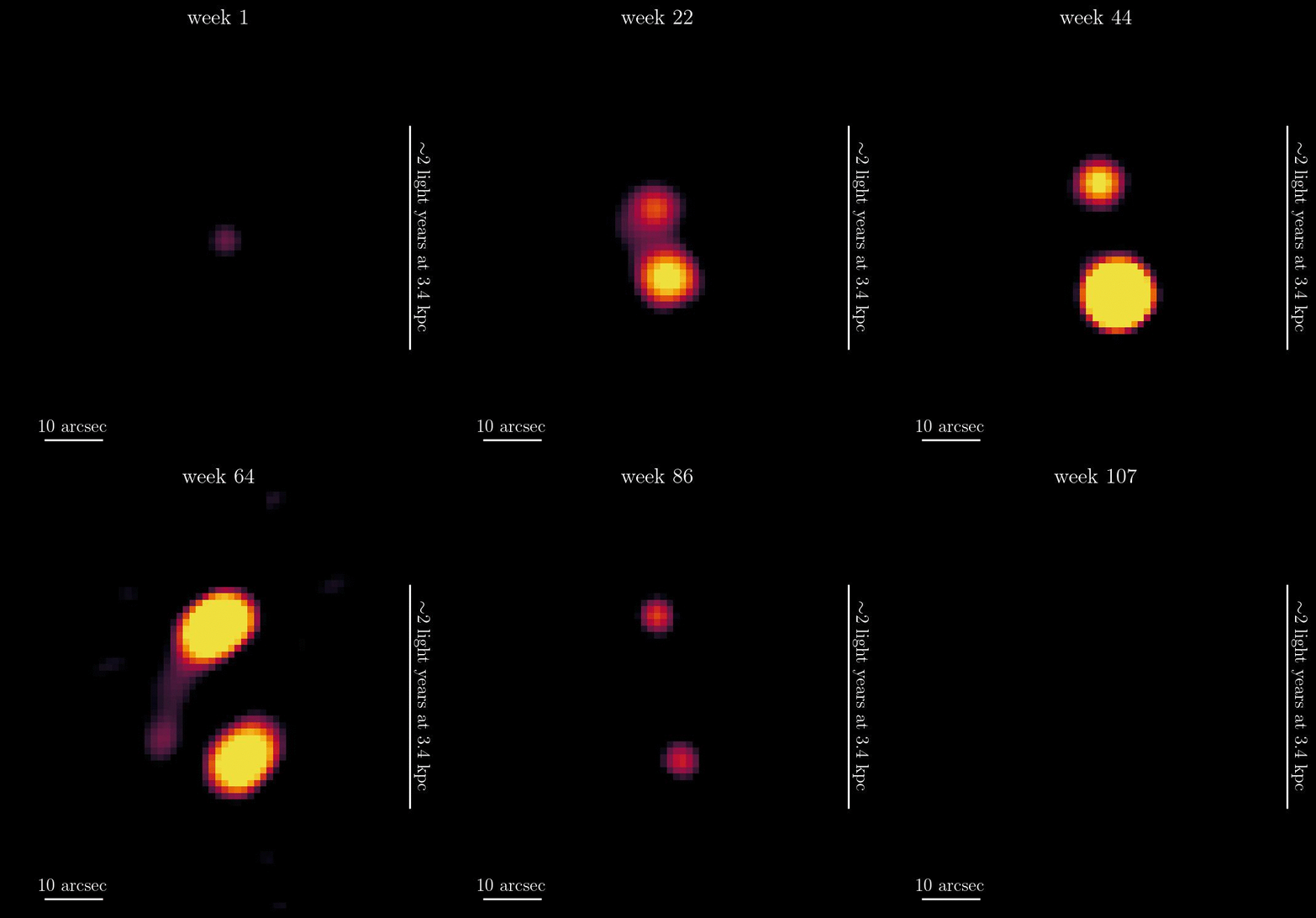
I use observational data across the electromagnetic spectrum to study the changes and evolution of accretion behavior around compact objects and jets they produce. This includes study of transient systems with focused campaigns, or performing wide surveys to study a large sample. The image on the right is from
this paper, in which our radio monitoring with the ThunderKAT survey allowed us to study the propagation of the X-ray binary jet through the cluster.
Galactic population and kinematics of black holes and neutron stars
Trying to achieve a holistic view of black holes and neutron stars in our galaxy from our biased incomplete observational samples is a fascinating challenge. A few pieces of this puzzle can be obtained through the study of black holes and neutron stars' motions in our Galaxy with the consideration of Galactic dynamics and potential, as these compact objects still carry signatures of their birth (supernova or collapse).
Evolution of black holes and neutron stars in star clusters
Globular clusters create a lot of fascinating phenomena involving compact objects through dynamical interactions. My team and I study the link between what we can observe in these systems and theory of binary formation and evolution.
Astro-statistics: Time-series analysis
Analysis of temporal patterns in astronomical data have a rich history and a lot of potential. A large subset of techniques for these sort of analysis rely on evenly sampled time series (light curves), which is generally not available in astronomy. I work on time-series methods that can help us overcome some of the challenges in unevenly and sparsely sampled timeseries. These broadly include spectral-domain simulations and gaussian processes.
Astro-statistics: Bayesian physical-statistical models
The term "physical-statistical model" is a term coined by Wikle in 2003 in reference to statistical models which are designed and informed by the physics of the system and observations being studied. Many astronomers build and use such models for inference regularly. What I focus on in this domain is particularly on physical random processes and how we can leverage our physical knowledge to improve our stochastic statistical models.
Data Science: Data-intensive analysis and visualisation
Besides astrophysics and statistics research and teaching, I also sometimes work with industry partners on analysis and visualisation of large spatio-temporal data (via GIS-aware softwares, Power-BI, Tableau, Python- and R- based frameworks, etc.).